The Role of API in Automation: The Nervous System of Finance (2026)
If your business software is the engine, then the Application Programming Interface (API) is the nervous system. In the past, software tools were isolated islands. Today, the role of api in automation is to connect these islands into a single, functioning continent. For finance teams transitioning to the cloud in 2026, understanding this connectivity is no longer optional it is the bedrock of efficiency.
Why do some automations break instantly while others run smoothly for years? The answer usually lies in the underlying architecture. This guide dissects the strategic role of api in automation, comparing it to older technologies like RPA, and explaining why it is the preferred method for scaling high-growth operations.
Table of Contents
- 1. What Is the Role of API in Automation?
- 2. API vs. RPA: The Stability Factor
- 3. The Mechanics: Endpoints and Webhooks
- 4. Speed and Latency: Why Minutes Matter
- 5. Security Protocols in API Data Transfer
- 6. Building the “Composable Enterprise”
- 7. Future Trends: AI Agents and APIs
Comparison: UI Automation vs. API Automation
| Feature | RPA (UI Automation) | API Automation |
|---|---|---|
| Interaction Method | Simulates mouse clicks | Code-to-Code requests |
| Stability | Low (Breaks if UI changes) | High (Versioning ensures stability) |
| Speed | Human speed (x5) | Light speed (Milliseconds) |
1. What Is the Role of API in Automation?
At its core, the role of api in automation is to provide a standardized language for applications to communicate. It allows a trigger in one system (e.g., receiving an invoice email) to execute an action in another (e.g., updating a Google Sheet).
According to the Postman State of the API Report, over 50% of development effort today is spent on APIs. Why? Because without them, automation is impossible. APIs transform software from a static tool into a dynamic service that can be commanded remotely.

2. API vs. RPA: The Stability Factor
Many businesses confuse API automation with RPA (Robotic Process Automation). RPA relies on “screen scraping” it programs a bot to click buttons on a screen. If the software provider updates their interface and moves a button, the bot crashes.
In contrast, the role of api in automation is to bypass the user interface entirely. It talks directly to the database. This makes API-based workflows significantly more resilient. As we discussed in our business document automation guide, stability is key for financial compliance.
3. The Mechanics: Endpoints and Webhooks
To understand how this works, you need to know two terms:
- Endpoints: These are the digital doors of an application. For example, ParserData has an endpoint specifically for `/extract-invoice`. You send a file to this address, and it returns data.
- Webhooks: Often called “Reverse APIs.” Instead of your automation asking “Is there new data?” every minute (polling), a Webhook instantly pushes a notification when an event occurs.
Webhooks define the real-time role of api in automation. They eliminate delays, ensuring that your ledger is updated the second a transaction occurs.
4. Speed and Latency: Why Minutes Matter
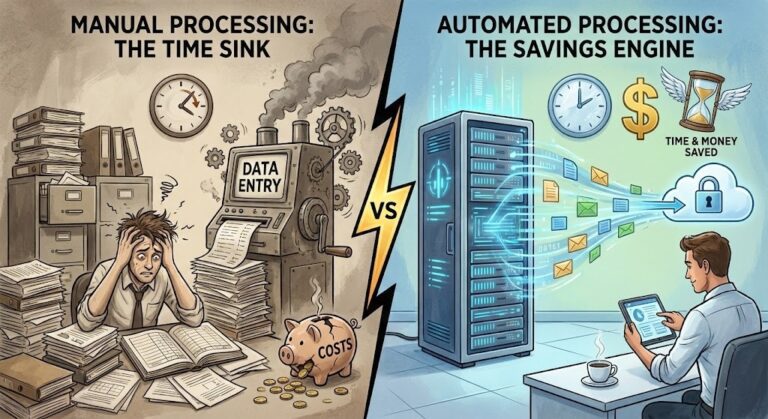
In finance, data latency (the delay between an event and the data availability) costs money. Manual entry has a latency of days. API automation reduces this to milliseconds.
By leveraging tools like ParserData, you can process thousands of documents per hour. This scalability allows businesses to handle seasonal spikes without hiring temporary staff, decoupling revenue growth from operational costs.
5. Security Protocols in API Data Transfer
Security is the primary concern for any CTO. The role of api in automation includes enforcing strict access controls. Unlike a CSV file emailed to a colleague, APIs use:
- Encryption in Transit (TLS 1.3): Protecting data as it moves through the internet.
- OAuth2 Tokens: Ensuring only authorized applications can access the endpoint.
Cloudflare notes that API security is now the frontline of data defense. Using APIs allows you to revoke access instantly if a threat is detected, something impossible with downloaded files.
6. Building the “Composable Enterprise”
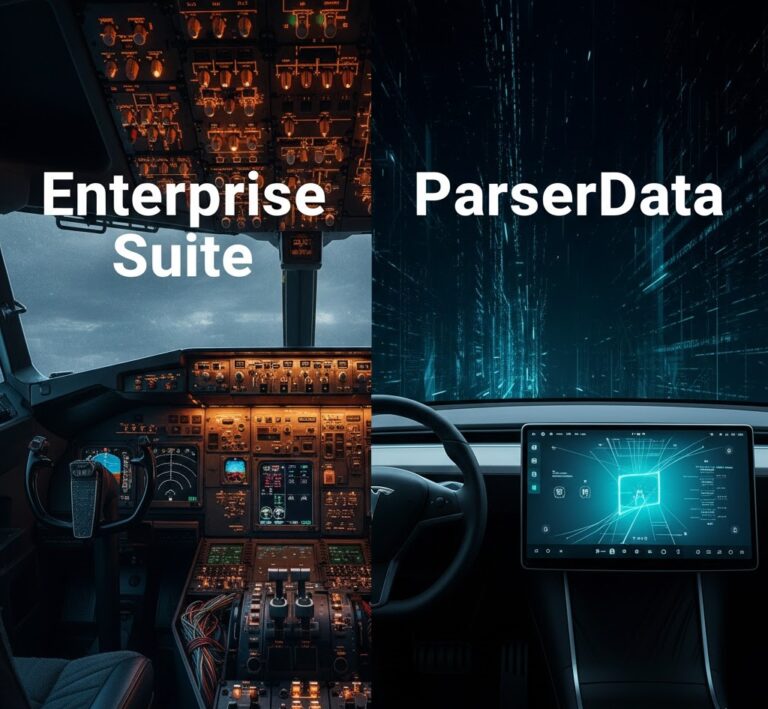
Leading organizations are moving towards a “Composable” architecture. Instead of buying one giant, monolithic software suite that does everything poorly, they buy the best tool for each job and connect them via APIs.
The role of api in automation here is to act as the glue. You might use ParserData for extraction, QuickBooks for accounting, and Slack for notifications. APIs allow you to swap out any single component without breaking the whole system.
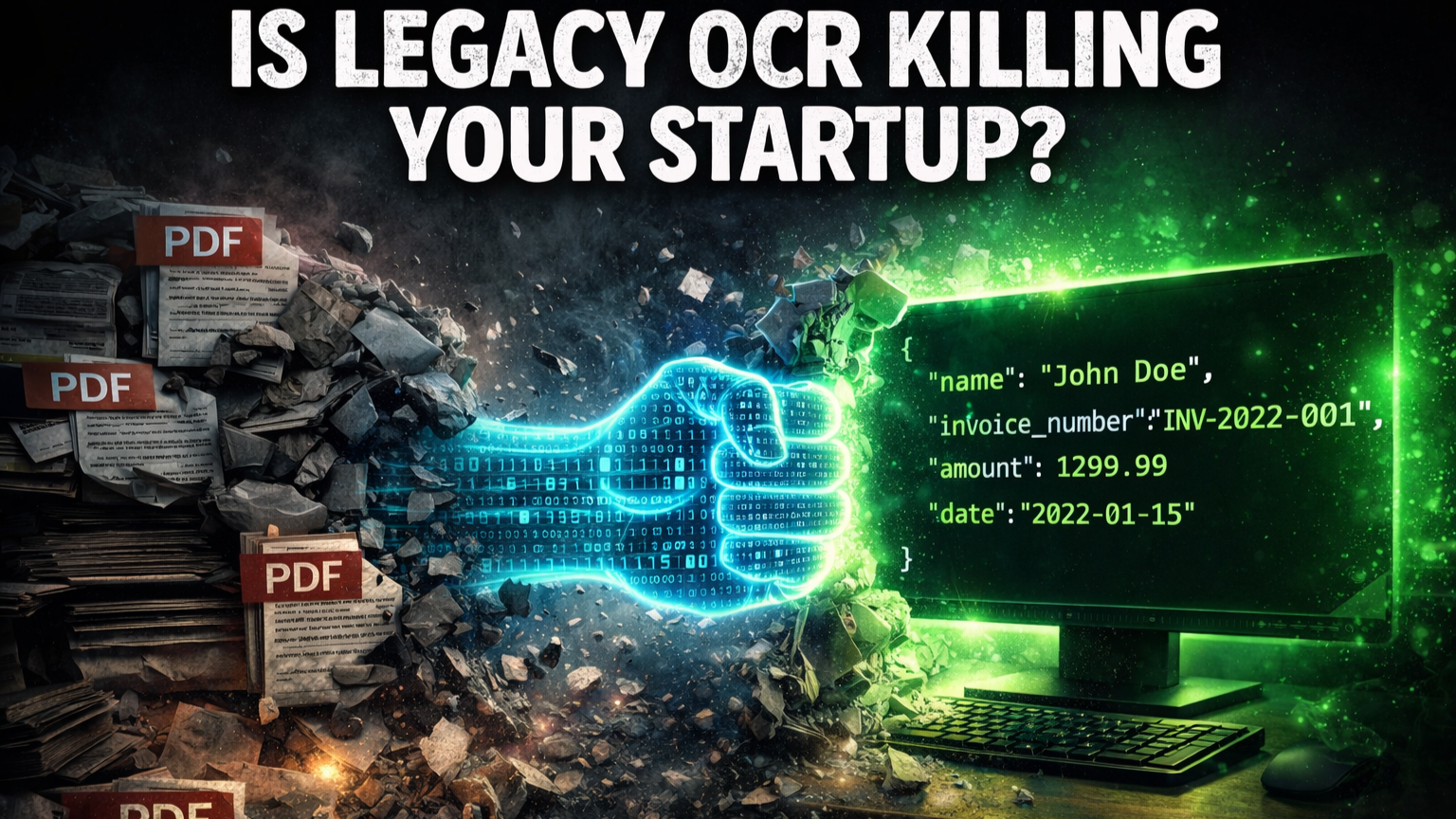
Want to see the ‘nervous system’ in action? Here is a 30-second demo of our API turning messy PDFs into structured JSON 👇
7. Future Trends: AI Agents and APIs
The future involves AI Agents that can read API documentation and build their own workflows. Imagine telling an AI: “Connect my invoice parser to my bank account,” and the AI writes the API integration for you.
To prepare for this future, you must start standardizing your data flows today. We have created a simple n8n workflow template to help you understand the basics of API connectivity.
🚀 Download API Integration Template
Pro Tip: Always handle API “Rate Limits” gracefully. If you send too many requests too fast, the server will block you. Build “Retry Logic” into your automation to handle these pauses automatically.
Conclusion
The role of api in automation cannot be overstated. It is the fundamental technology that enables speed, security, and scalability in the modern enterprise. By moving away from brittle user-interface automation and manual files, you build a resilient infrastructure capable of supporting rapid growth.
Ready to connect your systems? Start with ParserData and experience the power of a true API-first extraction platform.
Frequently Asked Questions
What is the main role of API in automation?
The main role is to act as a secure, standardized bridge that allows different software applications to talk to each other and exchange data automatically without human intervention.
How is API automation different from RPA?
RPA (Robotic Process Automation) mimics a human clicking buttons on a screen (UI). API automation happens in the background (code-level). APIs are faster, more stable, and less prone to breaking if the screen layout changes.
What is a Webhook and how does it relate to APIs?
A Webhook is a “reverse API“. Instead of asking for data repeatedly (polling), a Webhook sends data instantly when an event happens (e.g., “New Invoice Received“). It is crucial for real-time automation.
Are APIs secure for sensitive financial data?
Yes. Modern REST APIs use encryption (TLS) and token-based authentication (OAuth2). This ensures that only authorized systems can access the data, making them more secure than email attachments.
Can non-developers use APIs for automation?
Absolutely. Low-code platforms like n8n and Zapier provide visual interfaces for APIs. You don’t need to write code; you just connect the “nodes” visually to utilize the full power of API automation.
Recommended
- Why Use API for Data Integration? The 2026 Guide
- Data Quality in Automation: The Hidden Key to ROI
- How to Automate Data Extraction: 5 Step Guide
- Why Automate Data Processing? 5 Strategic Reasons
Disclaimer: All comparisons in this article are based on publicly available information and our own product research as of the date of publication. Features, pricing, and capabilities may change over time.