
Automate Document Processing in Finance: 5 Key Benefits (2026)
Manual document handling leaves even experienced data analysts battling repetitive errors and slow reporting, especially in environments where American regulatory deadlines are non-negotiable. In fact, over 30 percent of financial data errors stem from manual entry or transcription mistakes. This is exactly why leaders choose to automate document processing in finance to ensure compliance and speed. This guide breaks down how advanced technologies can dramatically reduce human error and deliver cleaner, more reliable reports.
Table of Contents
- Defining Automated Document Processing Technologies
- Major Types and Core Functions Explained
- Benefits when you Automate Document Processing in Finance
- Compliance, Audit Trail, and Regulatory Impact
- Risks When You Automate Document Processing in Finance
Key Takeaways
| Point | Details |
|---|---|
| Automated Document Processing Enhances Workflow | This technology streamlines document management by converting analog documents into digital formats and reduces manual errors. |
| Intelligent Document Processing (IDP) Automates Complex Tasks | IDP integrates AI to optimize document workflows, enabling recognition, classification, and intelligent routing of various document types. |
| Improved Financial Data Accuracy and Compliance | Automated processing increases reporting reliability, offering robust error-checking mechanisms and facilitating adherence to regulatory standards. |
| Strategic Planning is Essential for Implementation Success | Organizations must assess risks, budget accurately, and prepare staff to avoid common pitfalls during the implementation of document processing technologies. |
Defining Automated Document Processing Technologies
Automated document processing represents a sophisticated technological approach transforming how financial institutions manage complex paperwork. This technology goes beyond simple scanning, intelligently extracting structured data using advanced computational techniques like optical character recognition, natural language processing, and machine learning.
At its core, automated document processing involves converting analog documents into digital formats with remarkable precision. Financial organizations can now transform unstructured paper documents into searchable, analyzable digital assets. The process typically includes several key stages: document capture, image preprocessing, text extraction, data validation, and integration with existing business systems.
Modern intelligent document processing (IDP) integrates artificial intelligence to automate complex document workflows. These technologies can recognize various document types, extract relevant information, classify data, and route documents through organizational processes with minimal human intervention. Systematic document analysis enables financial teams to reduce manual errors, accelerate processing times, and allocate human resources more strategically.
Pro tip: When implementing automated document processing, start by digitizing a small, manageable set of documents to test accuracy and refine extraction parameters before scaling across your entire organization.
Major Types and Core Functions Explained
Intelligent document processing encompasses several critical types of automation technologies that transform how financial institutions handle complex documentation. These technologies range from basic digitization to advanced AI-powered extraction systems, each designed to address specific organizational challenges. Core document processing functions typically include image capture, content interpretation, data classification, and seamless enterprise system integration.
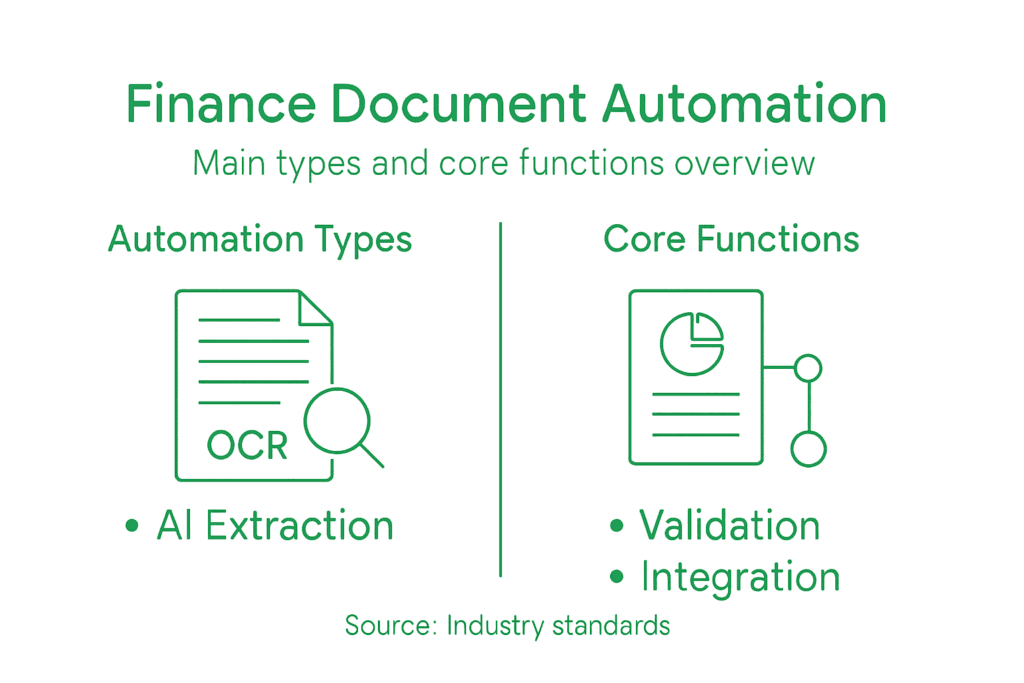
The primary types of automated document processing can be categorized into three main approaches: Optical Character Recognition (OCR), Intelligent Document Processing (IDP), and Advanced Machine Learning document extraction. OCR represents the foundational technology, converting scanned images into machine-readable text. IDP takes this further by adding contextual understanding, enabling systems to recognize document types, extract relevant information, and make intelligent routing decisions based on content.
To effectively automate document processing in finance, advanced technologies integrate multiple computational techniques to deliver sophisticated outcomes. These systems can now handle complex financial documents like invoices, tax forms, and compliance reports with remarkable accuracy. Financial management automation relies on standardized classification systems that enable precise data extraction, reconciliation, and reporting across organizational workflows. The most advanced systems can even learn and improve their extraction capabilities through continuous machine learning algorithms.
Below is a table helping you choose the right tools to automate document processing in finance based on typical use cases:
| Technology Type | Key Function | Common Use in Finance |
|---|---|---|
| OCR | Converts images to text | Digitizing checks, invoices |
| IDP | Extracts and classifies context | Automating loan applications |
| Machine Learning Extraction | Learns from data patterns | Complex tax and compliance forms |
Pro tip: When evaluating document processing technologies, prioritize solutions that offer flexible integration capabilities and demonstrate proven accuracy rates across multiple document types and formats.
Benefits when you Automate Document Processing in Finance
The initiative to automate document processing in finance delivers transformative advantages for financial reporting accuracy, fundamentally reshaping how organizations manage critical financial information. Accurate data reporting supports regulatory compliance, reduces human error, and enables real-time validation of financial records. By eliminating manual data entry processes, financial teams can dramatically improve the precision and reliability of their reporting systems.

The technological approach introduces multiple layers of data validation and error checking that traditional manual methods cannot match. Advanced systems leverage machine learning algorithms to cross-reference information, detect potential inconsistencies, and flag anomalies before they become significant reporting issues. This proactive approach means financial institutions can identify and correct potential errors instantly, rather than discovering problematic data during end-of-period reconciliation.
Advanced data analytics technologies enhance fraud detection capabilities by creating more robust, interconnected data verification mechanisms. These intelligent systems can simultaneously process complex financial documents, comparing information across multiple sources and identifying subtle patterns that might indicate reporting discrepancies or potential financial irregularities. The result is a comprehensive approach to financial data management that improves overall organizational transparency and regulatory compliance.
Pro tip: Implement a phased rollout of automated document processing technologies, starting with a pilot program that targets the most error-prone document types in your financial workflow.
Compliance, Audit Trail, and Regulatory Impact
Deploying systems to automate document processing in finance introduces robust compliance mechanisms that transform how financial institutions manage regulatory requirements. Audit trail documentation becomes significantly more comprehensive and reliable, creating immutable records of every document interaction, modification, and processing step. This approach ensures complete transparency, allowing organizations to demonstrate precise accountability during regulatory reviews and internal investigations.
The technological infrastructure enables financial teams to generate granular, time-stamped logs that capture every stage of document handling. Unlike manual processes prone to human error or intentional manipulation, automated systems create secure, unalterable records that meet the most stringent regulatory standards. These digital audit trails provide real-time visibility into document workflows, tracking user access, timestamps, and specific actions taken with financial documentation.
Regulatory impact analysis becomes dramatically more precise with automated processing technologies. Financial institutions can now demonstrate comprehensive compliance through standardized, consistent documentation that reduces administrative burdens while enhancing oversight capabilities. By implementing these advanced systems, organizations can proactively address potential regulatory challenges, creating a more transparent and accountable financial reporting environment.
Pro tip: Develop a comprehensive documentation strategy that maps each automated document process to specific regulatory requirements, ensuring seamless compliance and easy auditability.
Risks When You Automate Document Processing in Finance
Implementing automated document processing requires strategic planning and a comprehensive understanding of potential challenges. Risk management strategies are critical for financial institutions looking to minimize operational vulnerabilities and protect sensitive information. Cybersecurity threats, data integrity issues, and system reliability represent significant concerns that demand proactive and thorough evaluation before and during technology implementation.
Cost estimation presents another complex dimension of document processing automation. Financial teams must carefully analyze not just initial implementation expenses, but ongoing maintenance, training, and potential system upgrades. Cost management principles emphasize the importance of developing detailed financial projections that account for both direct technological expenses and indirect organizational adaptation costs. Underestimating these financial considerations can lead to budget overruns and project failures that compromise the entire digital transformation strategy.
The most common pitfalls when organizations attempt to automate document processing in finance stem from inadequate planning and unrealistic expectations. Organizations frequently underestimate the complexity of integrating new technologies with existing systems, fail to properly train staff, or neglect to establish robust governance frameworks. Successful implementation requires a holistic approach that considers technological capabilities, human factors, regulatory compliance, and long-term strategic alignment. Careful vendor selection, comprehensive testing, and phased rollout strategies can mitigate many of these potential risks.
The following table summarizes major risks in automated document processing and proven mitigation strategies:
| Risk Area | Typical Challenge | Mitigation Strategy |
|---|---|---|
| Cybersecurity | Exposure of sensitive data | Implement strict access controls |
| Cost Overruns | Underestimated expenses | Develop detailed financial modeling |
| Integration Issues | Compatibility with legacy systems | Run thorough pilot testing |
| Staff Adoption | Insufficient training | Provide ongoing education programs |
Pro tip: Conduct a comprehensive risk assessment and pilot program before full-scale implementation, documenting all potential challenges and developing specific mitigation strategies for each identified risk.
Unlock the Power of Automated Document Processing for Your Financial Workflows
Handling complex financial documents with speed and precision is a critical challenge for many organizations today. As the article highlights, the decision to automate document processing in finance resolves major hurdles like manual errors, data inconsistencies, and regulatory demands. Advanced terms like intelligent document processing and machine learning extraction reflect the necessity of automation that not only captures but validates and routes data efficiently.
One of the key benefits is hands-free operation. Watch how to automate the whole Gmail-to-Sheets process 👇

Parserdata tackles these exact challenges by transforming unstructured documents such as PDFs and images into clean, structured data formats like Excel, CSV, JSON, and XML. Our AI-powered platform accelerates your workflow while enhancing data accuracy and audit trail quality. You gain the ability to generate insightful visual reports that expose trends and anomalies before they impact your bottom line. Seamless API integration with tools such as Python, n8n, and Make.com makes Parserdata the ideal solution for forward-thinking financial teams.
Discover how you can reduce risks and cost overruns while boosting regulatory compliance by exploring Parserdata’s AI-driven document processing platform. Whether you are new to automation or refining your digital strategy, start your journey towards smarter, faster financial data management today.
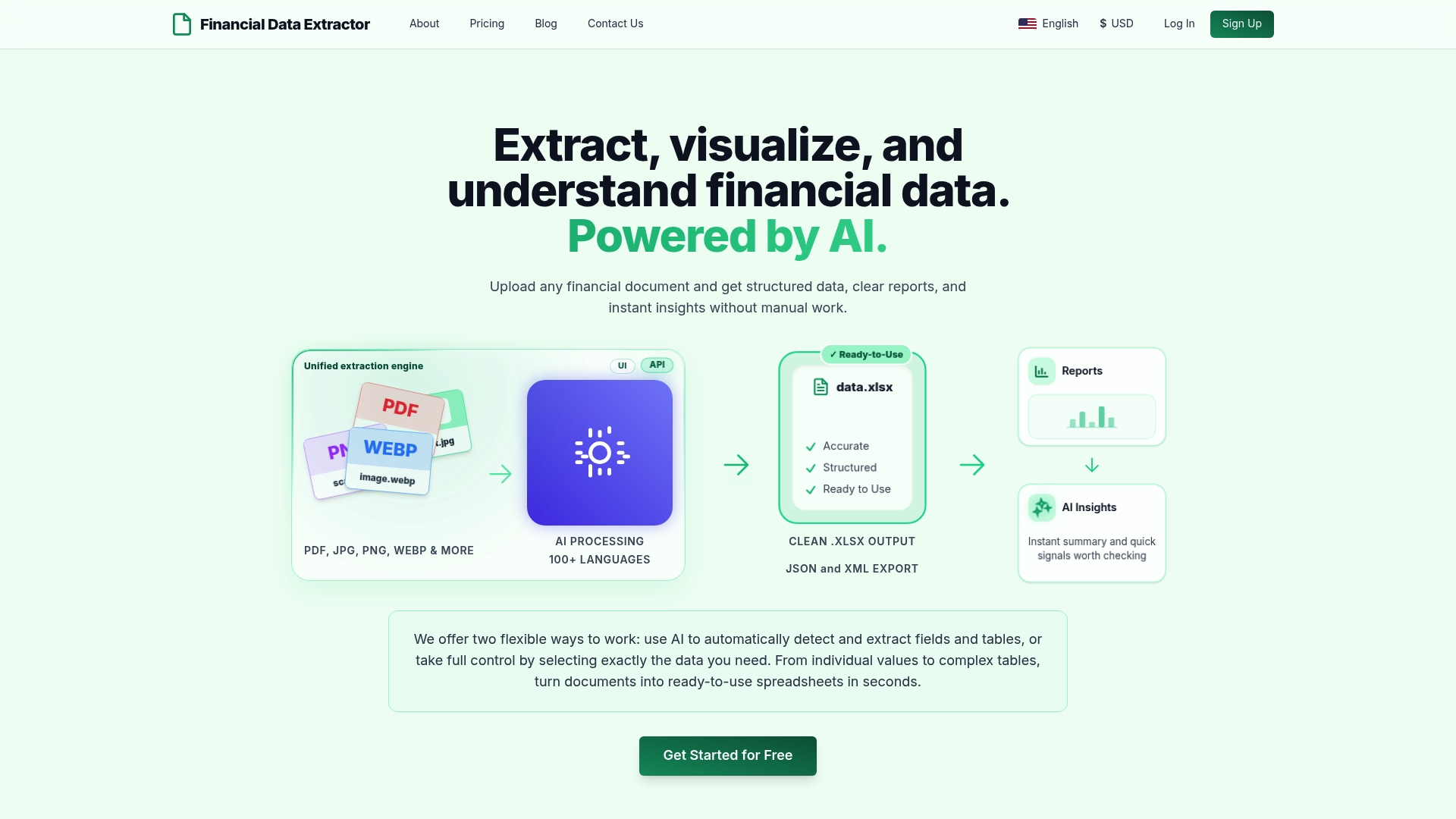
See the difference automation can make in your financial document handling. Visit Parserdata to automate document processing in finance and simplify your complex data extraction today.
Frequently Asked Questions
What are the primary benefits of automating document processing in finance?
Companies that automate document processing in finance see enhanced accuracy, faster workflows, reduced manual errors, and improved regulatory compliance, allowing teams to focus on strategic tasks.
How does intelligent document processing differ from traditional OCR?
Intelligent Document Processing (IDP) builds on Optical Character Recognition (OCR) by incorporating artificial intelligence to understand context, allowing for not just text extraction but also the classification and intelligent routing of documents based on their content.
What are the key stages involved in automated document processing?
The key stages typically include document capture, image preprocessing, text extraction, data validation, and integration with existing business systems, each contributing to transforming analog documents into digital assets accurately.
What risks should organizations consider when implementing automated document processing?
Organizations should consider cybersecurity threats, potential cost overruns, integration challenges with legacy systems, and staff adoption issues, ensuring they develop effective mitigation strategies for each identified risk.
Recommended
- Automated Invoice Processing: How to Eliminate Manual Data Entry Errors
- 6 Powerful Steps for Automating Data Extraction
- 6 Transformative Steps for Data Entry for Finance Teams in 2026 – Financial Data Extractor
- The Best AI Invoice Scanning Software (2025 Guide) – Financial Data Extractor
Disclaimer: All comparisons in this article are based on publicly available information and our own product research as of the date of publication. Features, pricing, and capabilities may change over time.