The Hidden Manual Invoice Processing Cost in 2026: A CFO’s Guide
In the high-stakes environment of corporate finance, efficiency is the ultimate currency. Yet, beneath the sophisticated ERP systems and complex financial dashboards, a silent profit-killer is draining capital from modern enterprises. That profit-killer is the manual invoice processing cost.
Most Chief Financial Officers (CFOs) and Accounts Payable (AP) directors know that processing paper and PDF invoices by hand is inefficient. However, when pressed for exact figures, few can accurately articulate their true manual invoice processing cost. They account for the salaries of their AP clerks, but they severely underestimate the compounding expenses of human error, late fees, missed discounts, and workflow bottlenecks.
According to landmark research by Ardent Partners, the average cost to process a single invoice manually can be shockingly high, often wiping out the profit margin of the very goods or services being purchased. In an era where Artificial Intelligence and API-driven automation are widely accessible, allowing high-paid financial professionals to act as data entry clerks is no longer just a minor inefficiency; it is a critical strategic failure.
In this authoritative Trust Asset report, we will rigorously deconstruct the manual invoice processing cost. We will provide you with the exact formulas to calculate your internal financial bleed, review 2026 industry benchmarks from leading research institutions, and demonstrate how transitioning to automated data extraction can slash these costs by up to 80%.
Table of Contents: The Financial Analysis
- 1. The Formula: Calculating Your Manual Invoice Processing Cost
- 2. Hard Statistics & Industry Benchmarks (Gartner, IOFM)
- 3. The 5 Stages of Waste: Where the Money Goes
- 4. The Hidden Toll: Late Fees and Duplicate Payments
- 5. Real-World Case Studies: The Impact on the Bottom Line
- 6. The Devastating Impact of “Fat-Finger” Errors
- 7. Slashing Costs with AI-Driven Data Extraction
- 8. Building the Business Case for Your CFO
- 9. Conclusion: Stop Paying to Pay
1. The Formula: Calculating Your Manual Invoice Processing Cost
You cannot optimize what you do not measure. To understand the gravity of the situation, you must calculate your organization’s specific manual invoice processing cost. The methodology goes far beyond simply dividing an AP clerk’s salary by the number of invoices processed.
A comprehensive audit of your manual invoice processing cost must include the following four pillars:
- Direct Labor Costs: The hourly wages, benefits, and taxes of the AP staff dedicated to opening emails, printing PDFs, typing data into accounting software, and filing documents.
- Indirect Labor Costs (Routing & Approvals): The time spent by department managers reviewing, disputing, and approving invoices. A manager earning $120,000 a year spending 3 hours a week hunting down purchase orders drastically inflates your manual invoice processing cost.
- Infrastructure & Overhead: The cost of physical storage, printing supplies, server space for disorganized digital files, and legacy software maintenance.
- Remediation Costs: The time spent fixing mistakes. Resolving a single discrepancy (e.g., a mismatched PO and invoice) takes exponentially longer than processing a clean invoice.
📊 The Calculation Formula
Total AP Department Cost (Labor + Overhead + IT + Error Resolution) / Total Number of Invoices Processed = Your True Manual Invoice Processing Cost.
2. Hard Statistics & Industry Benchmarks
If you have not run the calculation above, industry averages can provide a stark reality check. The world’s leading financial research institutions have closely tracked the manual invoice processing cost for over a decade.
The Ardent Partners Report
According to the State of ePayables report by Ardent Partners, the average manual invoice processing cost across all industries sits at roughly $10.18 per invoice. However, this is merely an average. For organizations with highly complex, multi-page invoices or decentralized approval workflows, the cost easily skyrockets to between $15.00 and $40.00 per document.
The IOFM Perspective
The Institute of Finance & Management (IOFM) reports similar findings, noting that “best-in-class” automated AP departments process invoices for less than $2.25 each. This represents a staggering 80% reduction in the manual invoice processing cost compared to bottom-tier, paper-heavy departments.
| Operational Maturity | Average Cost Per Invoice | Processing Time (Days) | Exception Rate |
|---|---|---|---|
| Laggard (Highly Manual) | $15.00 – $40.00+ | 14 – 25 Days | 17% – 25% |
| Average (Partial Automation) | $10.18 | 8 – 12 Days | 10% – 15% |
| Best-in-Class (Fully Automated API) | $2.25 – $3.00 | < 3 Days | < 2% |
Table 1: The stark contrast in manual invoice processing cost based on organizational maturity (Data sourced from IOFM & Ardent Partners benchmarks).
For context on how the “Best-in-Class” achieve these numbers, you must understand the underlying technology. We highly recommend reading our detailed breakdown of what is data extraction to see how machines interpret financial text.
3. The 5 Stages of Waste: Where the Money Goes
To truly dismantle the manual invoice processing cost, we must look at the lifecycle of a standard B2B invoice. Every time a human touches the document, the cost increases.
Stage 1: Receipt and Sorting
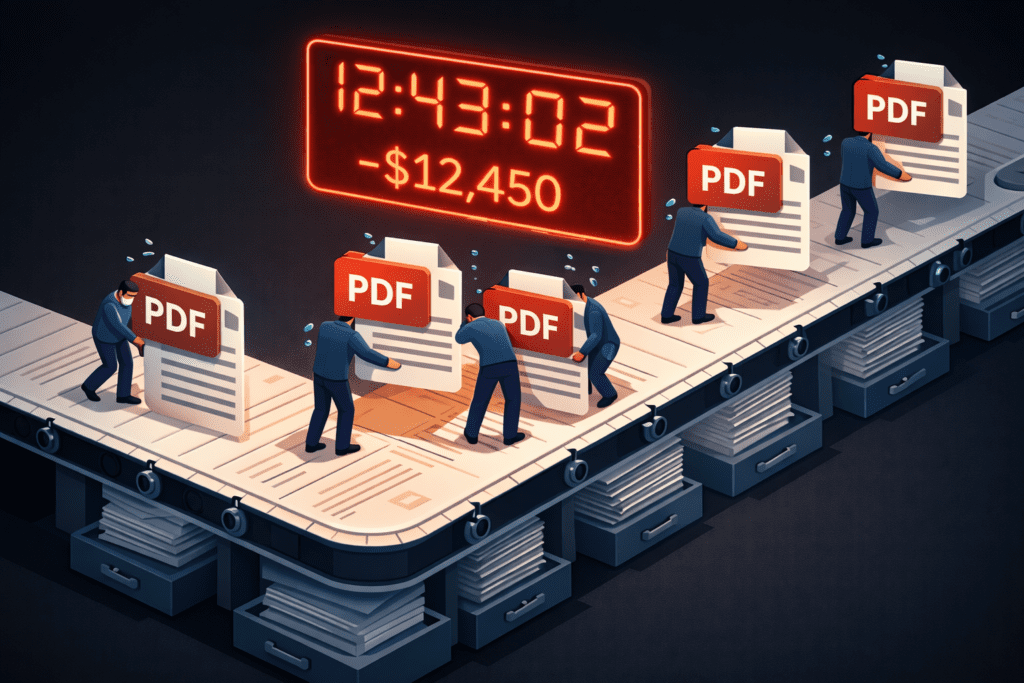
Invoices arrive via mail, email, or fax. An AP clerk must download the PDF, rename the file, and place it in a designated folder. This mundane sorting process contributes an estimated 10% to the total manual invoice processing cost.
Stage 2: Manual Data Entry (The “Stare and Type”)
This is the most expensive and dangerous phase. An employee looks at a PDF on one monitor and types the data (Vendor Name, Date, Line Items, Totals) into the ERP system on another monitor. This “stare and type” method is agonizingly slow and is the primary driver of the high manual invoice processing cost. To learn how modern teams bypass this, read our PDF to Excel invoice converter guide, or see our automated Invoice Line Item Extraction solution in action.
Stage 3: 2-Way and 3-Way Matching
The clerk must manually verify that the invoice matches the original Purchase Order (2-way match) and the Receiving Report (3-way match). Finding physical or digital copies of these supporting documents takes hours of forensic accounting work.
Stage 4: Exception Handling
If the numbers do not match (e.g., shipping was extra), the invoice becomes an “exception”. It is routed back to the buyer via email for clarification. Exception handling is the black hole of AP, single-handedly doubling the manual invoice processing cost for that specific transaction.
Stage 5: Approval Routing
Finally, the document is sent to a manager for approval. Because this is done via email chains rather than an automated dashboard, invoices sit in crowded inboxes for days, delaying payment.
4. The Hidden Toll: Late Fees and Duplicate Payments
The calculated manual invoice processing cost of $15 per document is bad enough, but the indirect costs of manual workflows are often more financially devastating.
- Missed Early Payment Discounts: Many vendors offer a 2% discount if paid within 10 days (2/10 Net 30). Because a manual workflow takes an average of 14 days, companies forfeit tens of thousands of dollars in free capital.
- Late Payment Penalties: Conversely, when manual bottlenecks delay processing beyond 30 days, vendors apply strict late fees, directly damaging the bottom line.
- Duplicate Payments: When a vendor emails an invoice twice because they haven’t been paid, manual AP teams occasionally process both PDFs. A study by the IOFM suggests that 0.1% to 0.5% of all manual payments are duplicates. In a company with $50M in AP spend, that is up to $250,000 lost to the ether.
Understanding these hidden factors is crucial for building a resilient finance team. For a broader look at avoiding these traps, explore our guide on 10 automation best practices to scale finance operations.
5. Real-World Case Studies: The Impact on the Bottom Line
Theoretical math is important, but practical evidence is what ultimately secures budget approval. Let us examine how organizations across different sectors suffer from a bloated manual invoice processing cost and how they successfully engineered a turnaround.
Case Study A: The Mid-Market Logistics Firm
A fast-growing logistics company was processing approximately 8,000 vendor invoices per month. Their AP department consisted of six full-time clerks. When they conducted an internal audit, they discovered their baseline manual invoice processing cost was hovering at $13.50 per document (totaling over $108,000 monthly in AP overhead).
The core issue was multi-page freight bills that required complex invoice line-item extraction. By implementing an AI-driven API, they eliminated the “stare and type” phase entirely. The software extracted the data and routed it to their ERP in seconds. Their manual invoice processing cost plummeted to just $2.10 per document. They reassigned four clerks to strategic vendor negotiation roles, saving over $1.1 million annually.
Case Study B: The Healthcare Provider
A regional healthcare network struggled with a decentralized approval process. Invoices were emailed to individual clinic managers who often forgot to forward them to central accounting. Their manual invoice processing cost was estimated at an astonishing $22.00 per invoice due to the sheer amount of time executives spent tracking down lost PDFs.
By shifting to an automated ingestion pipeline where all invoices hit a central API and were automatically routed for approval based on intelligent rules, they reduced processing time from 18 days to just 48 hours, capturing 100% of available early payment discounts. To understand the mechanics of this workflow, review our comprehensive step by step data extraction guide.
6. The Devastating Impact of “Fat-Finger” Errors
When calculating your total manual invoice processing cost, you cannot ignore the cost of human error. The term “fat-finger error” refers to the inevitable mistakes made by exhausted employees performing repetitive data entry.

Typing an invoice total as $10,000.00 instead of $1,000.00 is a classic fat-finger mistake. But the real financial damage is not just the overpayment; it is the cost of remediation. The McKinsey Global Institute notes that identifying, tracing, and fixing a data entry error costs up to ten times more than processing the data correctly the first time.
- The 1-10-100 Rule: In data quality management, it costs $1 to verify a record as it is entered, $10 to clean it up later, and $100 if the bad data results in a failed audit or lost vendor relationship.
- Audit Fines: In highly regulated industries, manual errors lead to compliance breaches. The legal fees associated with these breaches must be factored into your aggregate manual invoice processing cost.
For a deeper understanding of how to protect your databases from human contamination, read our deep dive into data quality in automation.
7. Slashing Costs with AI-Driven Data Extraction
The diagnosis is clear: the traditional manual invoice processing cost is an unsustainable burden. The cure is transitioning to intelligent, API-driven automation. However, buying a massive, million-dollar ERP module is not the only way to achieve this.
Why Legacy OCR Fails
Ten years ago, companies tried to lower their manual invoice processing cost using Optical Character Recognition (OCR). They built rigid templates for every vendor. When a vendor changed their invoice layout, the OCR broke, and the invoice required manual intervention anyway. The maintenance cost of legacy OCR often outweighed the savings.
The API & Semantic AI Revolution
Today, the most effective way to crush your manual invoice processing cost is by utilizing Semantic AI through lightweight APIs like ParserData to automate your invoice line item extraction. Semantic AI does not rely on templates. It reads the invoice contextually. It understands that “Total Due”, “Balance”, and “Amount Payable” all mean the same thing, regardless of where they are printed on the page.
By connecting an extraction API directly to your email inbox and your accounting software (via webhooks or platforms like Zapier), you achieve “Straight-Through Processing” (STP). The invoice arrives, the data is extracted with 99%+ accuracy, and the ledger is updated all without a single keystroke from your staff. If you are currently evaluating heavy enterprise solutions, we highly recommend reviewing our comprehensive automated invoice processing comparison to see how agile APIs stack up against legacy OCR platforms.
8. Building the Business Case for Your CFO
As a financial controller or operations leader, you must pitch this digital transformation to your CFO. You cannot simply say, “We need new software”. You must present a bulletproof financial argument proving that the current manual invoice processing cost is destroying enterprise value.

Step 1: Calculate the “Cost of Inaction” (COI)
CFOs respond to risk. Show them the Cost of Inaction. If your manual invoice processing cost is $12 per invoice, and you process 5,000 invoices a month, you are spending $60,000 monthly just to pay your bills. Multiply that by 12 months, and your COI is $720,000 a year. This is cash set on fire.
Step 2: Present the ROI Timeline
API solutions operate on a pay-per-use model. As shown in our recent automated invoice processing comparison, instead of a $150,000 upfront software licensing fee, you pay pennies per extracted document. Show the CFO that by dropping the manual invoice processing cost from $12.00 to $2.00, the technology pays for itself in the very first month of deployment. There is no multi-year payback period.
Step 3: Highlight Strategic Reallocation
Do not frame automation as “firing the AP staff”. Frame it as resource reallocation. When you eliminate the manual invoice processing cost, you free up trained financial professionals to conduct spend analysis, negotiate better vendor terms, and focus on working capital optimization.
| Metric | Current Manual State | Future Automated State (API) | Net CFO Benefit |
|---|---|---|---|
| Processing Cost | $12.50 per invoice | $2.00 per invoice | 84% Cost Reduction |
| Cycle Time | 14 Days | 12 Hours | Capture 100% of Early Discounts |
| Error Rate | 3.5% | < 0.5% | Elimination of Duplicate Payments |
| Staff Focus | Data Entry (Clerical) | Data Analysis (Strategic) | Higher Employee Output & Morale |
Table 2: The CFO ROI Matrix comparing current state vs. API automation.
💡 Pro Tips for AP Automation Deployment
1. Start with the 80/20 Rule: Do not try to automate 100% of your highly complex, handwritten edge-case invoices on day one. Focus your API extraction on the top 20% of vendors who send 80% of your standard PDF invoice volume. Secure that massive ROI first.
2. Enforce the “No Paper” Mandate: To truly minimize your manual invoice processing cost, you must mandate that vendors send digital PDFs to a centralized billing email. Actively penalize or transition away from vendors who insist on mailing physical paper.
3. Use Human-in-the-Loop: Configure your extraction API to auto-approve invoices where the AI is 95%+ confident. Route the remaining 5% to a human clerk for a quick 10-second visual review. This guarantees perfect data integrity while still capturing massive speed gains.
Manual entry costs time and money. Watch how 1 hour of manual work turns into 10 seconds of AI magic 👇

9. Conclusion: Stop Paying to Pay
Every dollar spent on an unnecessarily high manual invoice processing cost is a dollar stolen directly from your company’s profit margin. It is a highly regressive tax on your own operations.
In a hyper-competitive 2026 economic landscape, relying on human beings to read PDFs and type numbers into a screen is a fundamental misallocation of human intelligence. The technology to fix this Semantic AI, secure APIs, and automated routing workflows is no longer experimental; it is the industry standard.
It is time to audit your AP department, calculate your true financial bleed, and make the transition to an intelligent extraction pipeline. Stop paying a premium just to pay your bills. Explore ParserData today and permanently reduce your processing costs.
Frequently Asked Questions (FAQ)
What is the average manual invoice processing cost?
According to industry benchmarks from institutions like Ardent Partners and IOFM, the average manual invoice processing cost ranges from $10 to $15 per document. However, for organizations with highly decentralized workflows, this cost can easily skyrocket to over $40 for complex, multi-page invoices with line-item discrepancies.
How do you calculate the manual invoice processing cost?
You calculate your manual invoice processing cost by dividing the total operational cost of your Accounts Payable workflow (which includes direct labor, managerial approval time, IT infrastructure, software maintenance, and error remediation costs) by the total number of invoices your team successfully processes in a given month.
Why is the manual invoice processing cost so disproportionately high?
The cost is driven primarily by slow, expensive human labor. Tasks such as opening emails, manual data entry (stare and type), routing PDFs to department heads for approval, tracking down missing purchase orders, and fixing “fat-finger” typo mistakes consume countless hours of administrative time.
How much can automation reduce the manual invoice processing cost?
By implementing AI-driven extraction APIs (like ParserData) and automated routing workflows, companies can bypass manual data entry entirely. This digital transformation can reduce your manual invoice processing cost by up to 80%, bringing the absolute cost down to less than $2.50 per invoice. If your team is evaluating different vendors, explore our automated invoice processing comparison to find the most cost-effective solution.
Are there hidden factors in the manual invoice processing cost?
Yes, absolutely. Beyond the direct labor involved, the true manual invoice processing cost includes severe financial penalties: missed early payment discounts (due to slow processing), strict late fee penalties, accidental duplicate payments, and the massive strategic opportunity cost of having your financial professionals act as data entry clerks.
Recommended Reading
- Legal Invoice AI Automation: The Complete 2026 Guide
- The Role of API in Automation: The Nervous System of Business
- What Is Excel Automation? The Ultimate Explainer Guide
- How to Extract Data from Documents: The Definitive Guide
Disclaimer: All comparisons in this article are based on publicly available information and our own product research as of the date of publication. Features, pricing, and capabilities may change over time.