35 Essential Types of Business Documents: The Best 2026 Guide
A business runs on ideas, but it survives on documentation. Every transaction, every hire, and every strategic decision generates a paper trail. In 2026, the volume of this “trail” has exploded into a digital highway. Understanding the different types of business documents is no longer just an administrative duty; it is a core competency for operational efficiency.
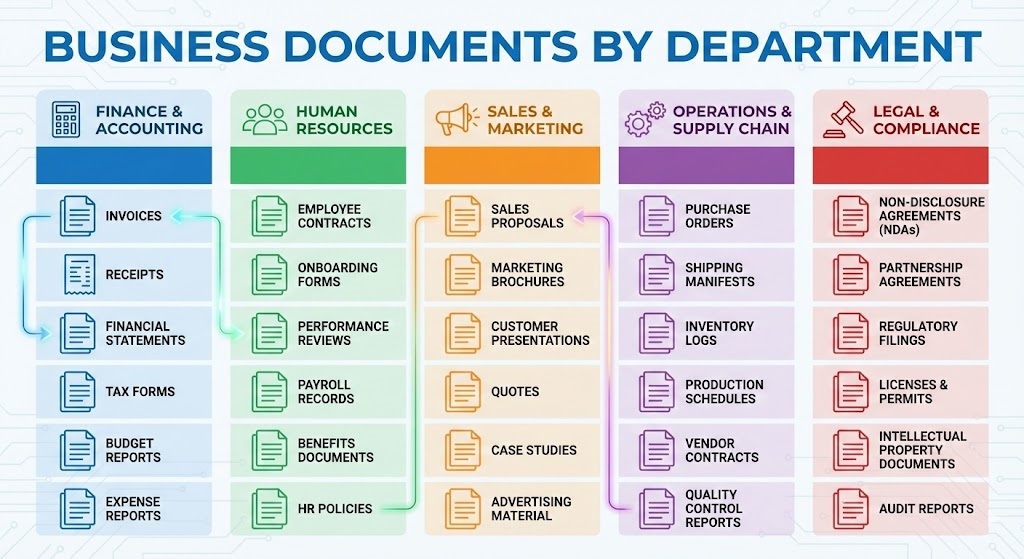
Whether you are a startup founder drafting your first contract or a CFO managing enterprise-level data, the sheer variety of files can be overwhelming. From financial records that keep the IRS happy to operational logs that keep the supply chain moving, each document serves a unique legal and functional purpose.
This comprehensive guide is your “Encyclopedia of Documentation.” We will categorize over 35 essential types of business documents, explain their anatomy, and most importantly, show you how to move them from static paper to dynamic, automated data streams.
Table of Contents
- 1. Financial Documents: The Lifeblood of Business
- 2. Legal & Compliance Documents: Protecting the Asset
- 3. HR & Employment Documents
- 4. Logistics & Supply Chain Documents
- 5. Strategic & Reporting Documents
- 6. How to Manage Document Chaos with Automation
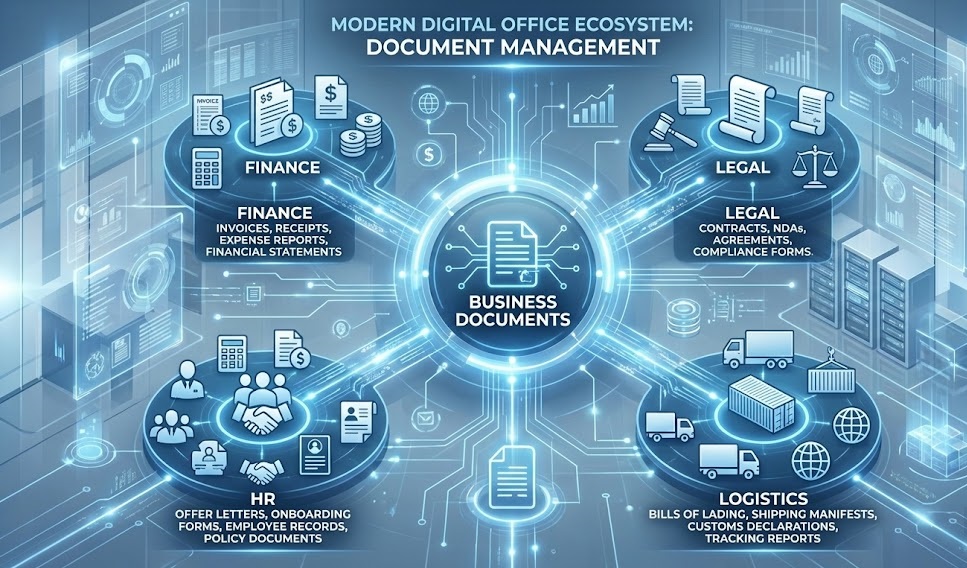
Quick Reference: Document Categories
| Category | Key Examples | Primary Stakeholder |
|---|---|---|
| Financial | Invoices, Receipts, P&L | CFO / Accountants |
| Legal | Contracts, NDAs, Bylaws | Legal Counsel |
| Operations | Bills of Lading, Inventory Logs | COO / Supply Chain Managers |
| HR | Offer Letters, Handbooks | HR Directors |
1. Financial Documents: The Lifeblood of Business
Of all the types of business documents, financial records are the most critical for survival. They track the flow of money in and out of the organization. Mismanagement here leads to cash flow gaps, tax penalties, and failed audits.
1.1. Invoices (Sales and Purchase)
An invoice is a commercial instrument issued by a seller to a buyer. It identifies the parties, lists the items sold, and requests payment.
Key Data Fields: Invoice Number, Date, Line Items, Tax Amount, Total Due.
Automation Potential: High. As discussed in our invoice extraction guide, AI can parse these automatically.
1.2. Purchase Orders (PO)
A Purchase Order is the mirror opposite of an invoice. It is issued by the buyer before the transaction to authorize a purchase. It is a legally binding offer to buy products.
Why it matters: It controls spending. Employees cannot buy software or supplies without an approved PO number.
Pro Tip: Automate “Three-Way Matching” by linking the PO, the Receiving Report, and the Invoice to ensure you only pay for what you ordered.
1.3. Receipts
While invoices request payment, receipts prove that payment happened. Unlike other types of business documents, receipts often come in difficult formats—crumpled thermal paper, blurry photos, and handwritten notes.
Solution: Use mobile capture tools that use OCR to digitize receipts immediately.
1.4. Financial Statements
These are high-level reports used by investors and management.
Income Statement (P&L): Shows revenue vs. expenses over time.
Balance Sheet: A snapshot of assets, liabilities, and equity at a specific moment.
Cash Flow Statement: Tracks the actual movement of cash (liquidity).
According to Investopedia, these three documents form the “holy trinity” of financial reporting required for public companies.
1.5. Tax Returns and Records
These documents must be retained for years to satisfy government audits (IRS, HMRC, etc.). Since tax authorities require strict accuracy, classifying these types of business documents correctly is vital to avoid penalties. They aggregate data from all the documents listed above.
1.6. Quotes and Estimates
Before an invoice is sent, a Quote outlines the estimated cost.
Best Practice: Use CRM software to convert approved Quotes directly into Invoices to avoid data entry errors.
1.7. Credit Notes
A document issued by a seller to a buyer to correct an error in an invoice or refund a return. It effectively “cancels out” part of a previous invoice.
2. Legal & Compliance Documents: Protecting the Asset
While financial documents track value, legal documents protect it. Among the types of business documents, these are the most sensitive. A single missing clause in a contract can cost millions in litigation.
2.1. Articles of Incorporation / Bylaws
These are the “birth certificates” of a company. They define the corporate structure, the number of shares, and the rules of governance. They are rarely changed but frequently referenced during due diligence or fundraising.
2.2. Non-Disclosure Agreements (NDA)
In the information age, intellectual property is gold. An NDA ensures that employees, contractors, and potential partners cannot steal your secrets.
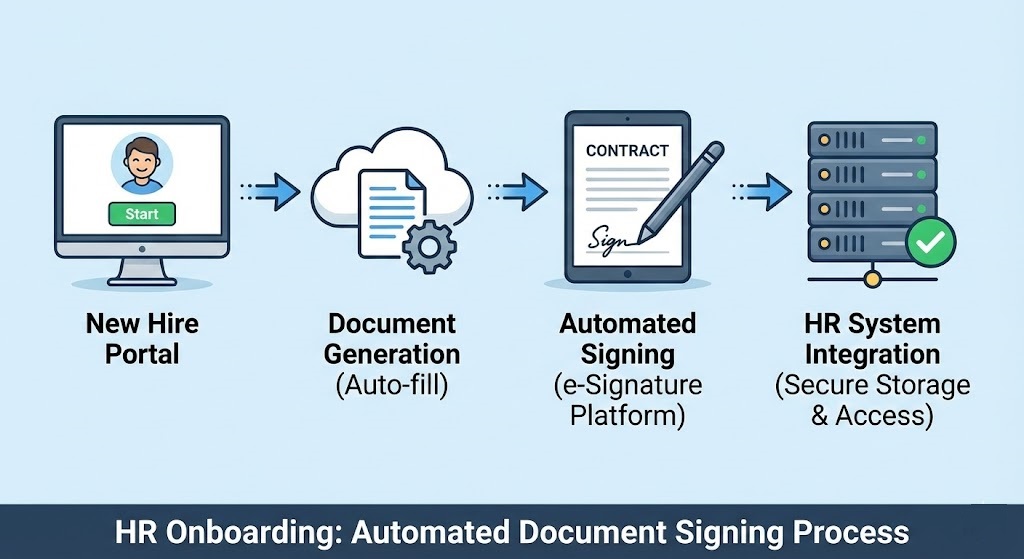
Automation Angle: Use templates to generate NDAs instantly when onboarding new clients, and use digital signatures (e-signatures) to track execution.
2.3. Client Contracts and Service Agreements (MSA)
The Master Services Agreement (MSA) outlines the broad terms of a relationship (payment terms, liability, dispute resolution). Specific projects are then added via “Statements of Work” (SOW).
Data Extraction Use Case: Large firms use AI to scan thousands of legacy contracts to extract critical dates (e.g., “When does this contract expire?”) to prevent unwanted auto-renewals. This is a key part of legal document automation.
Automating the management of these complex types of business documents reduces legal bottlenecks and ensures no critical renewal date is missed.
2.4. Memorandum of Understanding (MoU)
An MoU is less formal than a contract but more formal than a handshake. It outlines a mutual intent to work together. It is often used in the early stages of partnerships or joint ventures.
2.5. Privacy Policy & Terms of Service
These are external-facing legal documents required for any business with a website. They explain how you handle user data (GDPR/CCPA compliance) and the rules of using your service.
Pro Tip: Store all legal documents in a central, searchable repository. Never leave contracts in email inboxes. If a dispute arises 3 years later, finding the signed PDF immediately is crucial.
3. HR & Employment Documents
Employees are a company’s greatest asset, but managing them generates a massive volume of paperwork. HR documents are unique among the types of business documents because they are heavily regulated by labor laws. Losing an employee record can lead to lawsuits.
3.1. Offer Letter
This is the first formal document sent to a potential hire. It outlines the job title, start date, salary, and benefits. It is less detailed than a contract but serves as a formal invitation to join the team.
3.2. Employment Agreement (Contract)
Once the offer is accepted, the Employment Agreement cements the relationship. It covers:
- Non-compete clauses.
- Intellectual property ownership (everything the employee creates belongs to the company).
- Termination conditions.
For global companies, these must comply with local laws in every jurisdiction.
3.3. Employee Handbook
The Handbook is the “Rulebook” of the company. It details policies on vacation, harassment, dress code, and remote work. According to SHRM (Society for Human Resource Management), a well-written handbook is your first line of defense against employee disputes.
3.4. Termination Letter
The grim reality of business. This document formally ends the employment relationship. It must be drafted carefully to avoid “wrongful termination” claims, stating the effective date and severance details clearly.
3.5. Performance Reviews
These are periodic assessments of an employee’s work. They are critical for justifying promotions or firings.
- Best Practice: Digitize these immediately. If an employee sues for unfair dismissal, a documented history of performance reviews is your best legal defense.
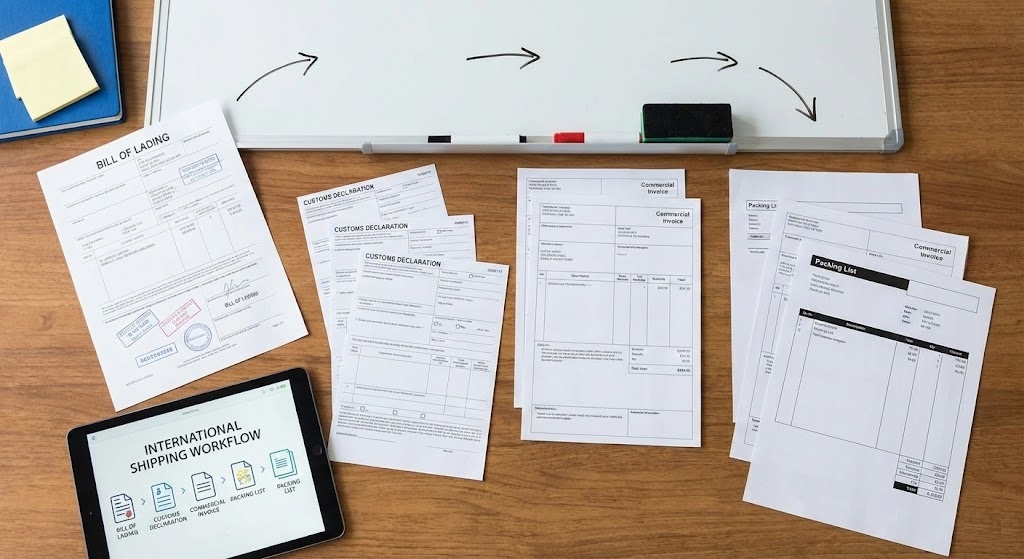
4. Logistics & Supply Chain Documents
If you sell physical goods, logistics documents are your lifeline. They are distinct from other types of business documents because they travel physically with the goods. Accuracy here prevents customs delays and lost cargo.
4.1. Bill of Lading (BOL)
The BOL is arguably the most important document in shipping. It serves three distinct roles:
- Receipt: Proof that the carrier received the goods.
- Contract: The agreement to transport the goods.
- Title: Proof of ownership. Whoever holds the BOL owns the cargo.
Automation Note: Extracting data from BOLs is a classic use case for supply chain data automation, as they are often scanned, messy documents passed between truckers and captains.
4.2. Packing List
While the invoice tells you how much it costs, the Packing List tells you exactly what is in the box (weight, dimensions, SKU). Warehouse staff rely on these specific types of business documents to verify incoming shipments against Purchase Orders.
4.3. Commercial Invoice
Unlike a standard sales invoice, the Commercial Invoice is used specifically for international trade and customs. It must include the Harmonized System (HS) codes, country of origin, and Incoterms. Errors here result in goods being stuck at the border.
4.4. Delivery Note (Proof of Delivery)
This is signed by the customer upon receipt. In the age of e-commerce, a digital “Proof of Delivery” (photo of the package at the door) has replaced the physical signature for many transactions.
4.5. Certificate of Origin
Some countries require proof of where goods were manufactured to determine tariffs. This document certifies the product’s nationality.
5. Strategic & Reporting Documents
These documents do not trigger daily transactions, but they define the future of the company. They are high-level and confidential.
5.1. Business Plan
The blueprint of the organization. It outlines the market analysis, revenue model, and operational strategy. It is essential for securing loans or investment.
5.2. Meeting Minutes (Board of Directors)
Legally, corporations are required to keep minutes of major meetings. These records prove that directors fulfilled their fiduciary duties. They track votes on key decisions like mergers, stock issuance, or executive hiring.
5.3. Annual Report
For public companies, this is mandatory. It combines financial performance with a narrative about the company’s year. Even for private companies, creating an annual report is a good discipline for transparency with stakeholders.
5.4. Pitch Deck
A visual presentation used to pitch investors. While not a legal document, it is a critical business asset that summarizes the Business Plan.
6. How to Manage Document Chaos with Automation
With so many different types of business documents flooding your organization daily, manual sorting is impossible. From financial records to legal agreements, every category requires a unique workflow. We have listed over 25 specific types of business documents so far. Managing them manually is a recipe for disaster. How do you tame this beast in 2026?
The solution lies in the “Digitization Triangle“: Storage, Extraction, and Integration.
Phase 1: Centralized Storage (DMS)
Stop saving files on desktops. Use a Document Management System (DMS) like SharePoint, Google Drive, or Notion.
- Rule: If it isn’t in the cloud, it doesn’t exist.
Phase 2: Automated Extraction (IDP)
This is where the magic happens. Instead of typing data from invoices and BOLs, use Intelligent Document Processing (IDP).
Tools like ParserData use AI to read these documents. For example:
- It reads a PDF Invoice.
- It identifies “Total Amount” and “Vendor Name“.
- It converts this into a JSON format.
This transforms “dead” pixels into “live” data. Read our 5-step guide to automation to implement this.
Phase 3: Integration (API)
Once the data is extracted, it needs to go somewhere. Use APIs to send invoice data to QuickBooks, or HR data to Workday automatically. This eliminates double-entry and ensures your systems are always in sync.
To help you get started, we have a pre-built workflow for automating the most common document type: the invoice.
BUTTON: 🚀 Download Document Automation Template
Conclusion
Understanding the different types of business documents is the first step toward operational maturity. But simply knowing them isn’t enough. In 2026, the winners will be the companies that can process these documents fastest.
By moving from physical paper to digital assets, and then to automated data streams, you reduce risk, save money, and free your team to focus on what really matters: growing the business. Do not let paperwork be the bottleneck of your success.
Frequently Asked Questions
What are the most critical types of business documents for startups?
For startups, the most critical documents are the Business Plan, Articles of Incorporation, Non-Disclosure Agreements (NDAs), and financial records like Invoices and Receipts for tax purposes.
How long should I keep different types of business documents?
Retention periods vary by law. Generally, tax records should be kept for 3-7 years, while major contracts and corporate bylaws should be kept permanently. Always consult a legal expert for local compliance.
What is the difference between an Invoice and a Purchase Order?
A Purchase Order (PO) is sent by the buyer to the seller to request goods. An Invoice is sent by the seller to the buyer to request payment after goods are delivered. They mirror each other in the transaction cycle.
Can all business documents be digitized?
Yes, almost all modern business documents can and should be digitized. Using tools like ParserData allows you to convert physical paper into searchable, structured digital assets.
Why is document standardization important?
Standardization ensures that data flows smoothly between departments. If every department uses a different invoice template, automation becomes difficult and error rates increase.
Recommended
- Data Quality in Automation: The Hidden Key to ROI
- Master Legal Document Automation Workflow
- 6 Proven Steps for Supply Chain Data Automation
- What Is Data Extraction? The Complete Guide
Disclaimer: All comparisons in this article are based on publicly available information and our own product research as of the date of publication. Features, pricing, and capabilities may change over time.